
Things to do in Giethoorn: tips from locals
Giethoorn, the 'Venice of the North', attracts visitors from all over the world. Most of them walk the same stretch of canal, take the same boat tour and leave again. That's a shame, because the real magic is just around the corner. We live and work here, so here's our guide: the classics, the places most tourists never see, and the practical things you want to know before you go.
Giethoorn in a nutshell
- Where: in the province of Overijssel, in the north-east of the Netherlands, about 1.5 hours from Amsterdam.
- What makes it special: the old village has canals instead of streets, with thatched farmhouses on little islands connected by wooden bridges. Much of it can only be reached on foot, by bike or by boat.
- The name: according to local legend, the first peat diggers found the horns of wild goats here, drowned in an old flood. 'Geytenhoren' (goat horns) became Giethoorn.
- Around it: Weerribben-Wieden National Park, the largest lowland peat wetland in north-west Europe, with lakes, reed beds and a network of quiet cycle paths.
1. Explore the canals by boat
The classic, and for good reason: Giethoorn looks best from the water. You have two options.
A guided canal tour is the easiest choice. Tours usually last about an hour, depart from several spots in the village and take you along the main canal (the Dorpsgracht) and often out onto one of the lakes. A skipper tells you about the village and its history. No planning needed, you just step on board.
Sail yourself in a 'whisper boat' or open boat. These electric boats are quiet, easy to steer and you don't need a boating licence. You get a map with a route and can stop wherever you like. Tip: steer carefully in the narrow canals, give way to tour boats, and don't moor at private gardens.
Want to rent a boat? We work together with our partner Giethoorn.com, where you can rent an open boat ('sloep') to explore the canals and lakes at your own pace.
Want a boat trip without organising it yourself? On our Discover Giethoorn & Weerribben tour a 2.5-hour trip in a luxury open boat is included, combined with an e-chopper ride, coffee, apple pie and lunch.
2. Walk the canal path
A narrow footpath runs along the main canal, crossing dozens of arched wooden bridges. Walking it is free and gives you the best close-up view of the farmhouses, their immaculate gardens and the boats gliding by.
Keep in mind that people actually live here. Many bridges and gardens are private property: if there's a sign saying 'privé' or 'verboden toegang', please don't cross. Stay on the path, keep your voice down and ask before photographing people. Residents are used to visitors, and a little respect goes a long way.
Local tip: the path is busiest between 11:00 and 16:00, when tour buses arrive. Come early in the morning or in the early evening and you'll have the canals almost to yourself, with the most beautiful light for photos.
3. Escape the crowds in Weerribben-Wieden National Park
This is what most visitors miss. The moment you leave the village, you're in one of the most beautiful nature reserves in the Netherlands: an endless landscape of reed beds, peat ponds, meadows and wide lakes such as the Beulakerwijde and the Belterwijde. For centuries people cut peat and reed here by hand, which created the typical pattern of long strips of land ('ribben') and water.
The park is known for its wildlife. Look out for herons, great egrets, marsh harriers and kingfishers. It's also home to the large copper butterfly, which is found almost nowhere else in the Netherlands, and the otter has been successfully reintroduced here. You're unlikely to see an otter during the day, but spotting a heron at the waterside is almost guaranteed.
The best way to see the park is on two wheels, over the quiet cycle paths and dykes. You can cover much more ground than on foot, and you can stop wherever the view is best.
4. Ride an e-chopper through the national park
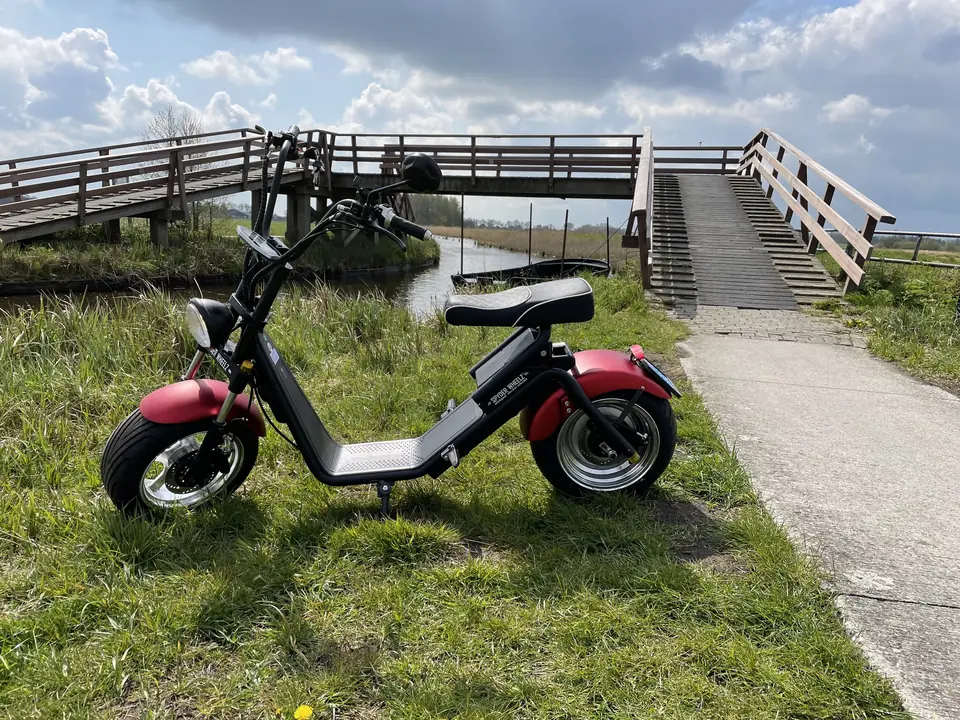
An e-chopper is an electric scooter in chopper style: fat tyres, a low comfortable seat and a top speed of about 25 km/h. It's completely silent, so you hear the birds and the wind in the reeds instead of an engine. Our favourite ride: through Belt-Schutsloot and on to the historic harbour of Blokzijl, two of the most beautiful places to cruise through in the whole area.
You ride on the cycle paths, so you can go anywhere a regular bike can. Every e-chopper has a phone holder and USB charger, and we have ready-made GPS routes along the most beautiful spots. You need a valid car driving licence. Want to take a child or partner along? Choose a duo e-chopper. Prices start at € 32.50 for 2 hours.
5. Rent a bike: the electric fat bike
The Netherlands is made for cycling, and the area around Giethoorn is flat, quiet and full of well-signposted cycle paths. The Dutch 'knooppunten' (junction) system makes it easy to find your way: every junction has a number, and you simply follow the numbers you've picked on the map.
No driving licence? Hop on an electric fat bike. You pedal yourself, but the motor gives you a push with every stroke, so even a headwind on the dyke is no problem. The wide tyres are comfortable and stable. You need to be at least 1.50 m tall, and there's no minimum age. Rental starts at € 26 for 2 hours.
6. Visit the quiet neighbouring villages
Giethoorn is not the only pretty village in the area, just the most famous one. These are all an easy ride away:
- Dwarsgracht: a tiny hamlet just west of Giethoorn, with the same canals and thatched farmhouses, but a fraction of the visitors.
- Belt-Schutsloot: a peaceful village by the water, surrounded by lakes and reed beds. One of the most beautiful places to cruise through on an e-chopper: quiet roads, water on both sides and pretty houses along the way.
- Kalenberg: deep inside the Weerribben, a small village of farmhouses along a canal. It shows what Giethoorn looked like before it became famous.
- Blokzijl: a historic harbour town from the Dutch Golden Age, about 10 km from Giethoorn, with an old lock, a picturesque harbour basin, and cafés and restaurants on the quay. Cruising through its historic streets and along the harbour on an e-chopper is a real treat, and it's a perfect stop for lunch.
- Wanneperveen: a long village on the edge of the lakes, with beautiful views over the water.
7. Eat and drink on a terrace by the water
Giethoorn and the surrounding villages have plenty of restaurants and cafés with terraces by the water. Try a slice of Dutch apple pie with whipped cream, or, if you're adventurous, smoked eel, a traditional speciality of the lake district.
Our meeting point, Restaurant Hollands Venetië on the Beulakerweg, is open every day. It's right by the water, so it's ideal for lunch or a drink before or after your ride, and there's plenty of free parking.
Sample itineraries
Half a day (3 to 4 hours)
Walk part of the canal path in the morning, then ride an e-chopper or fat bike for two hours through Dwarsgracht and Belt-Schutsloot. Finish with a drink on the terrace.
A full day
Start early with a boat trip or a walk along the canals before the crowds arrive. After lunch, ride out into the national park and on to Blokzijl for coffee on the harbour. Prefer to have everything arranged? Book our Discover Giethoorn & Weerribben tour: e-chopper, lunch and boat trip in one day.
An evening
When the day visitors leave, Giethoorn becomes wonderfully quiet. Our Evening Chopper Tour combines 1.5 hours on the e-chopper with a drink on the terrace and an evening boat trip through the village.
When to visit Giethoorn
- Spring (April to June): our favourite season. Everything is green, the birds are nesting and it's not too busy yet, except on public holidays.
- Summer (July and August): the busiest time, with long days and the best weather for boating. Come early or late in the day.
- Autumn (September and October): quieter, with golden reed beds and beautiful light. Ideal for riding and cycling.
- Winter: very quiet and atmospheric, but many boats and activities are limited. In a rare cold winter, the canals freeze and locals skate through the village.
- Day of the week: weekdays are always quieter than weekends.
How to get to Giethoorn
- By car: about 1.5 hours from Amsterdam and 30 to 40 minutes from Zwolle. Parking in and around the village is limited and often paid. At our meeting point at Hollands Venetië (Beulakerweg 167) there is plenty of parking. Get directions.
- By public transport: take the train to Steenwijk (from Amsterdam usually with a change in Zwolle), then the bus from Steenwijk station to Giethoorn. Check the latest times in the 9292 app or at 9292.nl.
- As a day trip from Amsterdam: very doable, but leave early. With the travel time, you'll have 5 to 6 hours in Giethoorn, which is enough for a boat trip and a ride through the national park.
Frequently asked questions
Is Giethoorn worth visiting?
Yes, especially if you go beyond the main canal. The village itself is unique, and the national park around it is one of the most beautiful nature areas in the Netherlands. Come early or late in the day to avoid the crowds.
How much time do you need in Giethoorn?
Half a day is enough to see the village and take a boat trip. With a full day you can also explore the national park and the neighbouring villages by e-chopper or bike, which we highly recommend.
Can you visit Giethoorn without a boat?
Yes. You can walk along the main canal, and the whole area is perfect for cycling or riding an e-chopper. Many of the most beautiful spots, like Dwarsgracht and Kalenberg, are easiest to reach on two wheels.
Do I need a licence to rent an e-chopper or fat bike?
For an e-chopper you need a valid car driving licence. For a fat bike you don't need a licence, but you must be at least 1.50 m tall. See our FAQ for more.